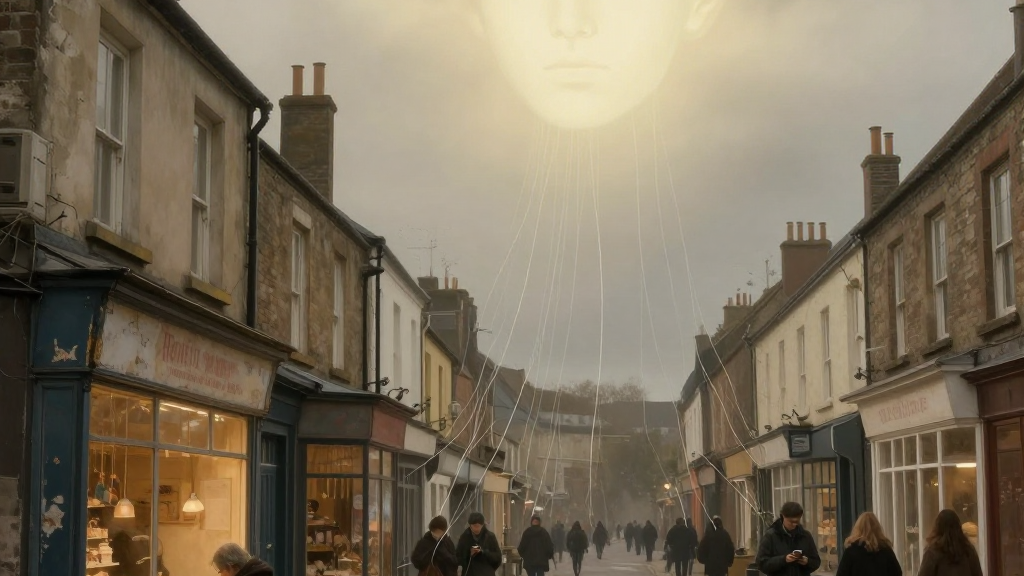
Convenience Is Hollowing Out Our Towns
By Alex R. · 9 April 2026
If we keep defaulting to big online platforms, local retail will not survive but we still have time to build something better.
If we keep defaulting to big online platforms, local retail will not survive ..but we still have time to build something better.
You do not notice the change at first.
A shop closes. Then another. A familiar window stays empty for months. Footfall drops. The café next door gets quieter. The street still exists, but something has gone out of it. It no longer feels like a place designed for people. It feels like a place waiting to be bypassed.
This is how decline happens now: not with one dramatic collapse, but with millions of quiet decisions.
A household item bought online instead of from the hardware shop. A birthday present ordered from a marketplace instead of the toy shop in town. A book delivered to the door instead of bought from the bookseller on the corner. Each decision makes sense on its own. It is quicker. Often cheaper. Easier. No parking, no queue, no effort.
That is why this matters.
The disappearance of local retail is not being driven by malice. It is being driven by convenience.
And if we continue to treat giant online platforms as the default place to buy everything, we should be honest about where that leads: fewer independent shops, weaker town centres, more fragile local economies, and a way of life organised increasingly around warehouses, vans, and algorithms rather than streets, relationships, and community.
This is not only about Amazon, though Amazon is one of the clearest examples of the model. It is about the wider platform economy: large online marketplaces that make shopping frictionless for consumers while making local retail harder to sustain.
The question is not whether these platforms are useful. They clearly are.
The question is what happens if they become the only game in town.
What disappears when shops disappear
We often talk about shops as if they are simply points of sale. They are not. They are part of the operating system of a place.
A local butcher, florist, pharmacy, bookshop, ironmonger, grocer, or clothes shop does more than sell stock. It creates routine. It creates trust. It creates jobs that people nearby can actually access. It keeps money moving around the local economy. It gives people reasons to be in town, which supports every other nearby business. It puts eyes on the street. It makes a place feel alive.
When enough shops go, the damage spreads beyond retail.
Less footfall means fewer customers for cafés and service businesses. Empty units make high streets feel neglected. Fewer visitors make town centres feel less safe and less welcoming. The loss becomes self-reinforcing: a place with fewer shops gives people fewer reasons to visit, which means even fewer reasons for businesses to stay.
This is not nostalgia. It is infrastructure.
We accept that roads, railways, broadband, and power networks are part of the infrastructure of a functioning society. Local retail belongs in that conversation too. It is part of how communities work in practice. Remove it, and the effects ripple outward.
The hidden cost of replacing streets with deliveries
Online shopping often feels more efficient because it removes one personal journey. But if enough physical retail disappears, we do not eliminate movement we reorganise it.
Instead of people combining errands in a town centre, goods travel individually from distant fulfilment centres to individual homes. More vans, more repeat journeys, more failed deliveries, more packaging, more pressure on roads and kerbsides, more neighbourhoods built around drop-offs instead of destinations.
This is not a simplistic claim that every delivery is worse than every shopping trip. The reality is more complicated. But the broader shift is clear: a retail system based overwhelmingly on home delivery creates a different kind of physical environment.
It weakens the role of shared public space and strengthens the role of private logistics.
That may sound abstract, but it affects how places feel. A town built around local trade invites people into it. A town built around delivery expects people to stay home and wait.
The jobs we lose are not easily replaced
Whenever this issue is raised, the response is often that e-commerce creates jobs too. That is true. Warehousing, logistics, software, fulfilment, delivery, customer support, and digital advertising all generate employment.
But that is not the whole picture.
The jobs created by large-scale e-commerce are not always in the same places, under the same conditions, or available to the same people as the jobs lost from local retail. Independent shops often provide first jobs for young people, flexible work for parents and carers, practical work for people without advanced qualifications, and pathways into ownership or management within the community itself.
These jobs are visible, local, and rooted.
A town can lose multiple independent businesses and not gain anything equivalent nearby. The economic activity may continue somewhere else in a warehouse on the edge of a city, in a centralised logistics hub, or on the balance sheet of a platform headquartered far away but that does not help the place that has lost its shopfronts.
So this is not just about the number of jobs. It is about what kind of jobs remain, where they exist, and whether the value they generate stays local.
Why local retailers cannot win alone
Big online platforms did not become dominant by accident. They solved real problems. They made shopping fast, searchable, and reliable. They offered huge choice and easy delivery. For many consumers, and for many small businesses, they felt transformative.
But over time, a platform can shift from being a tool to being a gatekeeper.
A small retailer is no longer simply competing with another nearby shop. It is competing with businesses selling nationally or globally through systems that benefit from scale, search visibility, data, logistics, and customer habits built around instant fulfilment. A family-run business cannot replicate that on its own.
This is why “shop local” on its own is not enough.
If local retail is going to survive, it needs more than goodwill. It needs modern infrastructure of its own.
The answer is not less technology. It is better technology.
Too many conversations about the high street are trapped in a false choice: old retail or online retail. Physical or digital. Tradition or modernity.
That is the wrong way to think about it.
The future worth building is not offline. It is digital support for real local commerce.
That means creating a fair shared marketplace where independent retailers with physical shops can sell online without being swallowed by the same extractive logic that weakened them in the first place.
Imagine a platform built specifically for local physical retailers.
One website or app where customers can search by product, town, distance, or category and instantly see what nearby shops already have in stock. They can order for collection, reserve an item, choose same-day local delivery, or visit in person. Instead of replacing the high street, the platform directs traffic back towards it.
This matters because it combines the best of both worlds: the convenience people now expect, and the local economic value towns still need.
Why a physical-shop rule matters
One of the strongest ideas is also one of the simplest: if a retailer wants to be part of this marketplace, it should have a real physical shop.
That condition changes everything.
It means the platform is not just another online marketplace open to anyone, anywhere. It becomes a digital tool for businesses that are already investing in local places. Businesses paying rent or rates. Businesses employing local people. Businesses holding stock in the community. Businesses that customers can actually walk into.
A physical shop creates accountability and trust. It ties digital trade to real-world contribution. It says that if a business benefits from a shared local platform, it should also be helping sustain the local economy that platform exists to protect.
That is a fair principle. And it would help distinguish a genuine alternative from just another website chasing transactions.
What a fair marketplace would need
If this kind of platform is going to work, it cannot copy the worst habits of the biggest online marketplaces. It must be fair by design.
That means transparent fees, not a maze of charges that punish small sellers. It means search rankings based on relevance, availability, service, and locality not simply whoever can spend the most on promotion. It means retailers keep their relationship with their customers, rather than handing that relationship over to an intermediary. It means support for click-and-collect, which reduces delivery pressure while increasing footfall. It means shared local delivery, so small businesses can offer convenience without carrying the logistics burden alone.
Most importantly, it should be governed in a way that reflects its purpose. The strongest version would be cooperative, mutual, or community-backed: built to serve retailers and towns, not to extract from them.
That is how you create a marketplace with values, not just volume.
What consumers need to understand
None of this requires people to abandon online shopping completely. That is unrealistic, and for many households unnecessary. The real issue is not whether we ever use large platforms. It is whether we use them automatically, without thinking about what repeated dependence does over time.
If people want local shops to exist in five years, they cannot spend as if they do not matter.
That does not mean every purchase must become a moral test. It does mean that convenience should not be the only value in the room. Price matters. Speed matters. But so do resilience, jobs, public life, local ownership, and the kind of town we leave behind for the next generation.
A community cannot outsource all its spending and still expect to keep its local economy.
What happens if we do nothing
If current habits continue, the direction is not hard to predict.
More local shops will close. More retail employment will shift away from town centres and towards centralised logistics. More high streets will become hollowed-out service corridors with less identity and less independence. More everyday trade will be mediated by a small number of platforms whose priorities are scale and efficiency, not the long-term health of local places.
And once that pattern is far enough advanced, rebuilding what was lost will be far harder than defending it now.
Because local retail is not like a light switch. You cannot simply turn it back on after years of neglect. Once the skills, premises, habits, and customer relationships are gone, they are gone.
The choice in front of us
This is not really about shopping. It is about what kind of country we are building.
One version of the future is organised around a small number of giant digital systems that deliver almost everything to our doors while local shops shrink into a niche or disappear entirely.
The other uses technology differently: to help local retailers compete, to make physical shops easier to find and buy from, and to keep money, jobs, and activity circulating in the places where people actually live.
That future is still possible.
But it will not arrive on its own. It has to be built by consumers who choose more deliberately, by retailers who collaborate instead of struggling alone, and by councils and communities that understand the high street is not a sentimental leftover from the past but a practical part of a functioning local economy.
The internet does not have to hollow out our towns.
But if we keep using it in ways that reward only scale, speed, and centralisation, that is exactly what it will do.
And by the time the last independent shop has gone, the bargain of convenience will no longer look cheap.